Fitness Trackers That Aren’t Watches: Bands, Rings and Clips
Four kinds of tracker with no watch face, and eight examples compared by where you wear them, how they charge and what they cost.

Four kinds of tracker that are not a watch
If you want your steps, sleep or heart rate recorded but do not want a watch, you have four choices: a wristband with no screen, a ring, a clip or pendant, or an arm band you wear only at night.
| Type and example | Where it goes | Charging | US price | Required subscription |
|---|---|---|---|---|
| Screenless band: Chargerless Ray | Wrist, or ankle with a suitable band | Light powered; no charging routine | $219 silver / $249 gold | None |
| Screenless band: Google Fitbit Air | Wrist | USB charger; up to seven days | From $99.99 | None for heart rate, sleep stages and sleep score |
| Screenless band: Polar Loop | Wrist | Rechargeable; up to 8 days | $169.99 | None |
| Screenless band: WHOOP 5.0 / MG | Wrist | Rechargeable; 14+ days | $199–$359 a year, hardware included | Required annual membership |
| Smart ring: Oura Ring 4 | Finger | Rechargeable; 5–8 days | From $349 | $5.99 a month or $69.99 a year |
| Smart ring: RingConn Gen 2 Air | Finger | Rechargeable; up to 10 days | $199 | None |
| Clip or pendant: Bellabeat Leaf | Clipped to clothing, or worn as a necklace or bracelet | Replaceable coin cell; about 6 months | $99 Leaf Urban / $89 Leaf Chakra | None; Bellabeat+ is optional |
| Sleep band: Garmin Index Sleep Monitor | Upper arm, overnight | Rechargeable; up to 7 nights | $169.99 | None |
Chargerless makes Ray. The other rows are each maker's published specifications and US list prices, checked between August 20 and November 3, 2026. This is a comparison of documented features, not a wear test.
A wristband without a screen
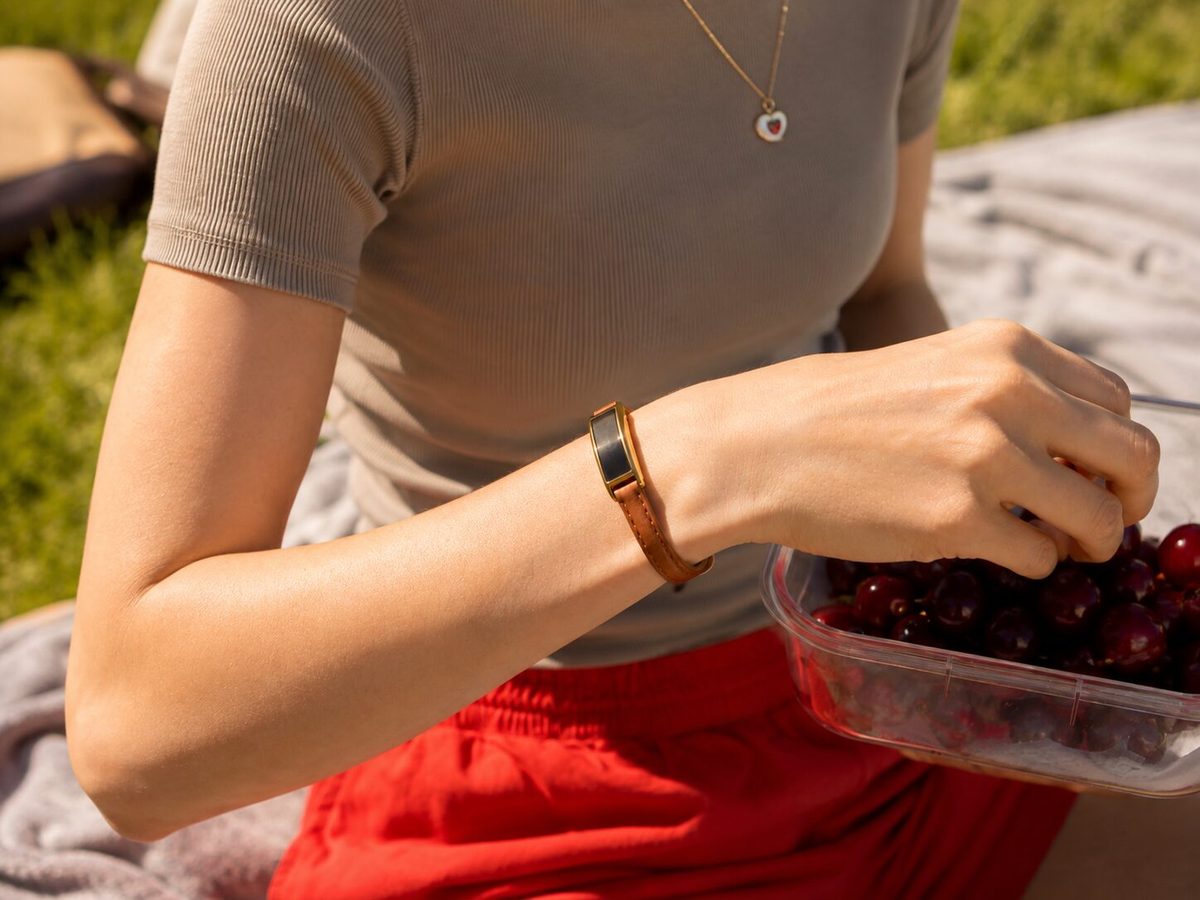
This is the closest thing to a watch's tracking without the watch. A small sensor sits on your wrist around the clock and the results appear in an app.
The bands above differ mainly in upkeep and fees. Fitbit Air, Polar Loop and WHOOP are recharged every one to two weeks, and WHOOP requires an annual membership. Ray is powered by light and has no subscription. For all six current options side by side, see screenless fitness trackers compared.
A band is also the easiest of the four to wear beside a real watch. If that is your plan, read what to wear with a mechanical watch.
A ring
A ring frees both wrists. It suits you if you dislike anything on your wrist or want tracking that nobody notices.
Rings are sized to one finger, sit where you grip, and are recharged every few days to two weeks. The table compares Oura Ring 4; Oura also sells Ring 5, from $399 as of November 9, 2026. Oura adds a membership fee; RingConn Gen 2 Air and Samsung Galaxy Ring do not. Our smart ring or fitness band guide covers comfort, sleep and charging, and Oura for your wrist is for people who like the idea of Oura but not the ring.
A clip or pendant
Bellabeat Leaf can be clipped to clothing or worn as a necklace or bracelet, and its coin cell lasts about six months. Its listed tracking is activity, sleep, stress and cycle context.
Check what a clip-on measures before you buy. If you want heart rate or HRV, confirm that the exact model records them, because a tracker that does not rest against your skin cannot be assumed to. See Ray and Bellabeat Leaf compared.
An arm band for sleep only
Garmin Index Sleep Monitor is worn on the upper arm overnight. It records sleep, HRV, respiration, Pulse Ox and skin temperature, and keeps both wrists free.
It is not a daytime tracker. Choose it if nights are all you want to measure; see Ray and the Index Sleep Monitor compared.
What you give up without a watch
- The time and notifications on your wrist. None of these show them.
- Stats during a workout. You read your pace, heart rate or timer afterward, in the app.
- Some workout features. Check which activities each one tracks. Ray does not currently track named workouts such as yoga or weight lifting.
If those are the features you use every day, a small watch may be the better tool.
Where Ray fits
Ray is a 7-gram, screenless band powered by light. It records sleep, heart rate, HRV, temperature trends, activity and light exposure, with the details in its companion app and no subscription.
About 1–2 minutes of direct sunlight can replenish a day's use under our test settings. Ordinary room lighting is not enough; see how Ray charges. The 7-gram figure is the device only, and your band adds to the worn weight.
Ray can also be worn on an ankle with a suitable band.
Before you buy
- Decide where you are willing to wear it, day and night.
- Check what it measures, and whether it needs skin contact to do so.
- Check how often it leaves your body to charge.
- Add up the membership, if there is one, over the years you expect to use it.
- Check that a ring or band comes in your size.
Want tracking without a watch face? Ray is a 7-gram screenless band powered by light.
See Ray options Ask a question