Longest Battery Life Fitness Trackers: Ranked by Days
Chargerless Ray runs on outdoor daylight with up to about 60 days of dark reserve. Compare 16 current fitness trackers, smart rings and watches ranked by published days per charge.

Battery life is the single specification that determines whether a fitness tracker stays on your body or ends up in a nightstand drawer. Compare published runtimes across categories and you immediately see a 60-fold spread — from 24-hour smartwatches to 7–21 day rechargeable bands to Chargerless Ray, which harvests outdoor light and holds up to about 60 days of dark reserve without a charging port.
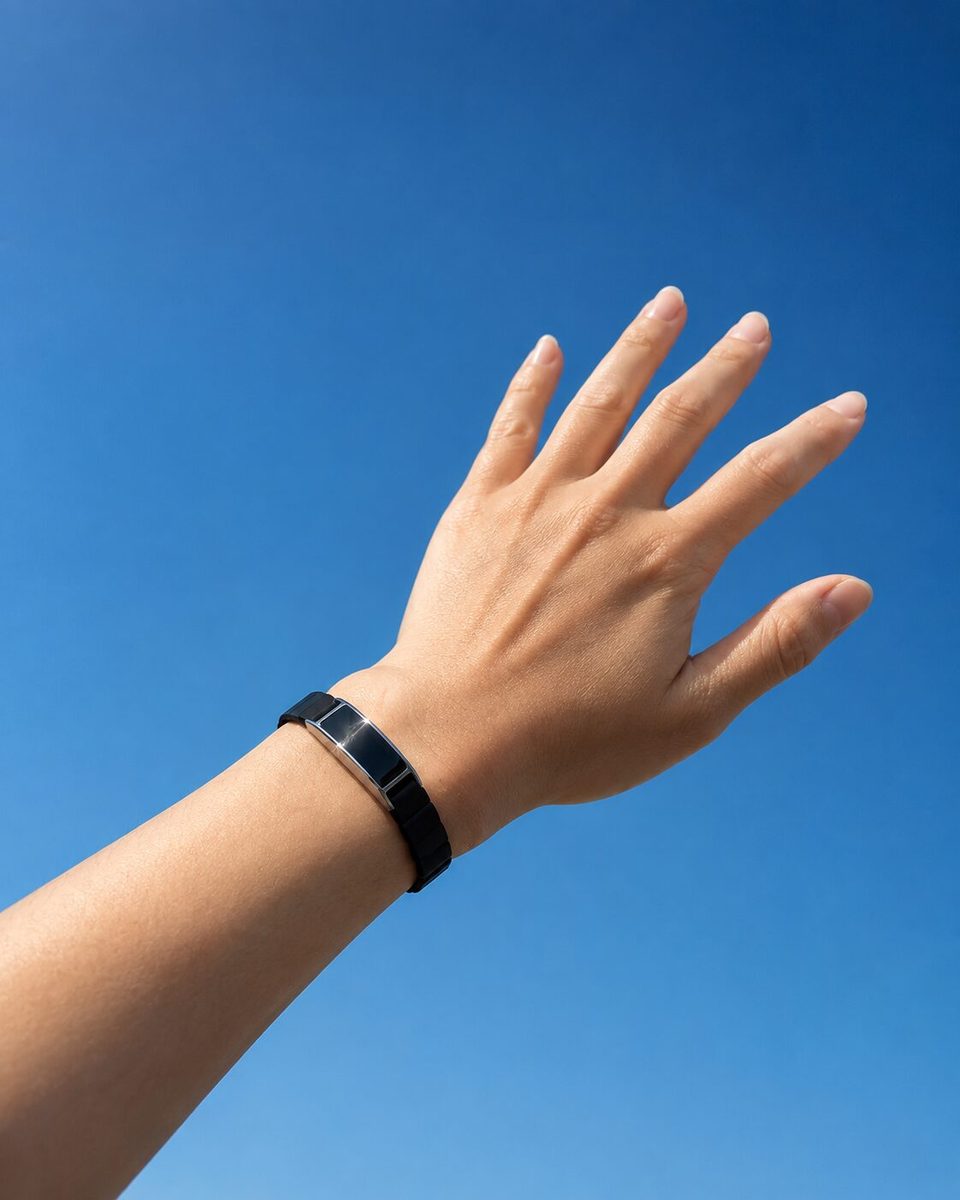
16 current fitness trackers ranked by battery life
The table below ranks 16 currently sold trackers across screenless bands, display bands, smart rings, clips and watches using each maker’s published upper runtime estimate (and Chargerless Ray’s ~60-day dark reserve from a full charge).
| Tracker | Category | Published runtime | Charging method | Weight | Required subscription |
|---|---|---|---|---|---|
| Chargerless Ray | Screenless band | Solar; up to ~60 days dark reserve | Built-in solar face (no port) | 7 g (case) | None ($219–$249) |
| Bellabeat Leaf | Clip / pendant | About 6 months | Replaceable coin cell | 16.5 g | None (Bellabeat+ optional) |
| Withings ScanWatch 2 | Hybrid watch | Up to 35 days | Rechargeable cradle | 34.6 g (case) | None (Withings+ optional) |
| Xiaomi Smart Band 10 | Display band | Up to 21 days | Magnetic USB charger | 15.95 g (case) | None |
| Amazfit Band 7 | Display band | Up to 18 days | Magnetic USB charger | 28 g (with strap) | None |
| Ultrahuman Ring PRO | Smart ring | Up to 15 days | Charging dock / PRO case | 3.3–4.8 g | None (PowerPlugs optional) |
| WHOOP 5.0 / MG | Screenless band | 14+ days | Basic Charger or Wireless PowerPack | 26.5 g (5.0) / 27.3 g (MG) | Yes ($199–$359/yr) |
| Hume Band | Screenless band | Up to 14 days | Rechargeable | 8.6 g (reported) | None (Hume Premium optional) |
| RingConn Gen 3 | Smart ring | 10–14 days | Portable charging case | 2.5–3.5 g | None |
| HUAWEI Band 10 | Display band | Up to 8 typical / 14 max | Magnetic USB charger | 14–15 g (case) | None |
| Garmin CIRQA | Screenless band | Up to 10 days | Proprietary plug (up to 90 min) | 14.8 g module / 20.7–21.2 g band | None (Connect+ optional) |
| Amazfit Helio Strap | Screenless band | Up to 10 days | Magnetic dock (USB-C) | 20 g | None for core |
| Fitbit Inspire 3 | Display band | Up to 10 days | Proprietary USB clip | 17.7 g | None (Premium optional) |
| Oura Ring 4 / 5 | Smart ring | 5–8 days (R4) / 6–9 days (R5) | Size-specific USB-C dock | 3.3–5.2 g (R4) / 2 g+ (R5) | Yes ($5.99/mo or $69.99/yr) |
| Polar Loop | Screenless band | Up to 8 days | Polar USB cable | 19.5 g module / 29 g band | None |
| Google Fitbit Air | Screenless band | Up to 7 days | USB charging cable | 5.2 g module / 12 g band | None for core (Premium optional) |
| Apple Watch Series 11 | Smartwatch | Up to 24 hours (38 hr Low Power) | Magnetic fast-charge puck | 29.7–43.1 g (case) | None (Fitness+ optional) |
Chargerless makes Ray. Competitor runtimes, weights and subscription terms are published manufacturer figures (or noted secondary sources) checked between August and November 2026. Filter all 40+ wearables by battery life, price and weight in the Wearable Finder or the fitness tracker comparison chart.
Why electrical power draw separates solar wearables from cable-charged bands
Published battery life mixes two different things: how big the battery is and how little power the electronics consume. A bulky band can hit 10 to 14 days by packing a larger lithium cell, whereas running indefinitely from ambient sunlight requires driving average electrical consumption down into the tens of microwatts.
In Chargerless’s power comparison, Chargerless Ray draws 15 µW with four-minute heart-rate sampling and step counting off. For comparison, Chargerless estimated average competitor power by dividing total stored battery energy by each product’s reported runtime: Google Fitbit Air at 790 µW (~53× Ray’s operating point), Garmin CIRQA at 2,040 µW (~136×), and WHOOP 4.0 at 6,300 µW (~420×).
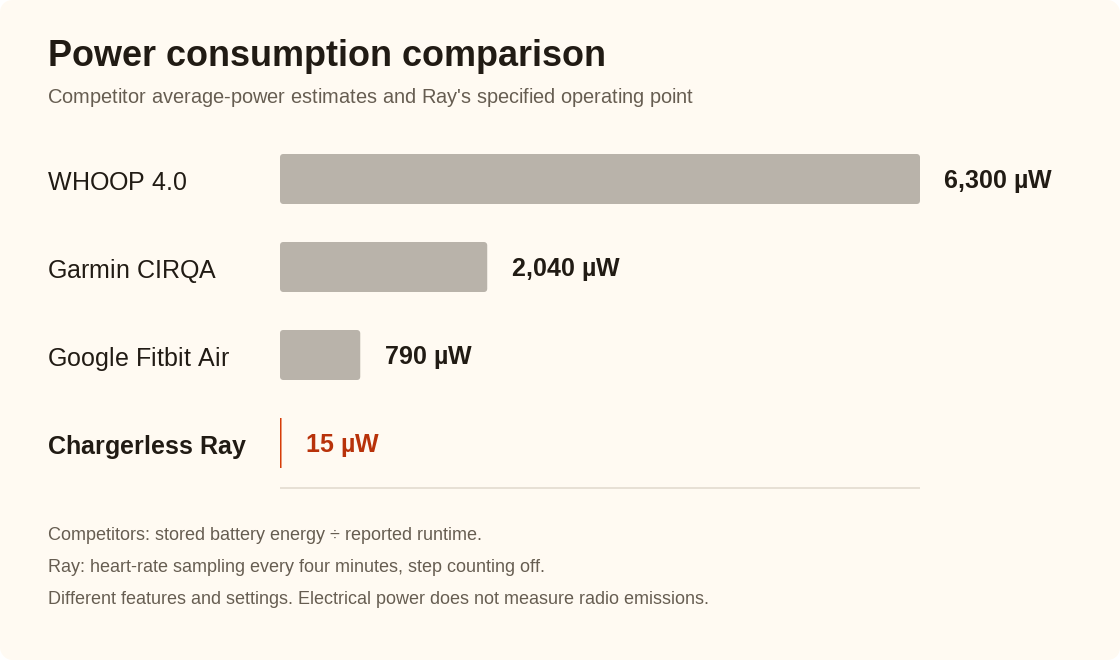
Those ratios explain why Chargerless Ray does not need a wall charger — and why features and settings matter when reading any battery spec. Because the four devices run different sensors, sampling rates and software stacks, the comparison is not an identical-feature test, and overall electrical power is not a measurement of Bluetooth RF emissions or exposure.
Rechargeable endurance vs. dark reserve vs. solar replenishment
When shopping by battery life, distinguish three very different power models:
- Standard rechargeable endurance (1 to 35 days). Every time the cell empties, the tracker comes off your wrist (or slides a battery pack on top, as with WHOOP’s Wireless PowerPack). Over a year, a 7-day band like Google Fitbit Air needs roughly 52 charge cycles; a 14-day band like WHOOP 5.0 needs roughly 26; a daily watch like Apple Watch Series 11 needs 365.
- Dark reserve (~60 days on Chargerless Ray). Even with zero charging light, a fully charged Chargerless Ray holds up to about 60 days of operation (depending on sampling settings and use). That dark reserve covers winter sleeves, long flights and weeks indoors without leaving gaps in your sleep log.
- Solar replenishment (~1–2 minutes of direct sun/day). Under Chargerless test settings, roughly 1–2 minutes of direct outdoor sunlight, 10–15 minutes of outdoor shade or about one hour right beside a bright window replaces one day of operation. Ordinary indoor room lighting contributes little, so outdoor walks, errands or coffee on a sunny step are what keep Ray topped up indefinitely. Read our sun, shade and window light tests for measured timings.
Best long-battery picks by category
- Best zero-cable everyday wrist tracker — Chargerless Ray ($219 silver / $249 gold): A 7 g, 33 × 11 × 6 mm polished stainless-steel screenless band with no charging port and no subscription. Tracks sleep, resting heart rate, overnight HRV, body temperature trends, steps, cycle tracking and light exposure, syncs with Apple Health, Google Health Connect and Samsung Health, and offers Airplane Mode to switch Bluetooth off completely while recording. Note that the stainless-steel case contains nickel (do not wear it if you have a nickel allergy) and currently ships within the United States.
- Best rechargeable screenless band for 2-week runtime — WHOOP 5.0 / MG or Hume Band: Both reach 14+ / up to 14 days per charge. WHOOP brings mature strain and recovery coaching with a required $199–$359/year membership; Hume Band costs $249 once with optional Hume Premium. If you prefer a 10-day band from Garmin or Amazfit without required fees, compare Garmin CIRQA vs. Fitbit Air or Ray vs. Amazfit Helio Strap.
- Best long-battery display band — Xiaomi Smart Band 10 (up to 21 days) or Amazfit Band 7 ($49.99, up to 18 days): Both keep an AMOLED touchscreen and sport modes while lasting two to three weeks between magnetic USB charges.
- Best long-battery hybrid watch — Withings ScanWatch 2 (from $369.95, up to 35 days): Real analog hands, a small grayscale display, ECG and SpO₂ with monthly rather than nightly charging.
- Best long-battery smart ring — Ultrahuman Ring PRO (up to 15 days) or RingConn Gen 3 (10–14 days): Both double Oura Ring’s typical recharge window with no required monthly subscription. Compare all rings on our smart ring comparison chart.
If your main goal is retiring a nightly or weekly charging habit altogether, start with how Chargerless Ray’s solar architecture works or compare your current routine in our fitness tracker charging routine guide.
Frequently asked questions
Which fitness tracker has the longest battery life overall?
For wrist-worn health tracking without a charging cable, Chargerless Ray harvests outdoor daylight (about 1–2 minutes of direct sun replaces a day under Chargerless test settings) and holds up to about 60 days of reserve in total darkness. Among coin-cell clips, Bellabeat Leaf runs about 6 months on a replaceable battery without optical heart-rate sensing, while Withings ScanWatch 2 leads rechargeable watches at up to 35 days.
Which screenless wrist tracker lasts longest on a single charge?
Chargerless Ray is designed for continuous solar wear with up to about 60 days of dark reserve. Among rechargeable screenless bands, WHOOP 5.0 / MG (14+ days) and Hume Band (up to 14 days) lead, followed by Garmin CIRQA (up to 10 days), Amazfit Helio Strap (up to 10 days), Polar Loop (up to 8 days) and Google Fitbit Air (up to 7 days).
Does Chargerless Ray charge under indoor office lighting?
Ordinary indoor room lighting contributes very little energy. Under Chargerless test settings, about 1–2 minutes of direct outdoor sunlight, 10–15 minutes in outdoor shade or roughly one hour next to a bright window replaces about one day of operation, while the ~60-day dark reserve buffers cloudy stretches and long sleeves.
Why do smartwatches have much shorter battery life than screenless trackers?
Bright always-on touchscreens, built-in GPS radios, background apps and notifications draw far more power than passive optical sensors. That is why Apple Watch Series 11 lists up to 24 hours per charge while screenless bands typically last 7 to 14+ days — and why ultra-low-power designs like Chargerless Ray can run from daylight alone.
Keep reading: WHOOP Won’t Charge?, WHOOP alternatives with no required membership, Ray vs. Polar 360 and Ray vs. Morpheus M7.
Skip the charging cable: Chargerless Ray tops up from outdoor daylight and holds up to about 60 days of dark reserve.
Explore Chargerless Ray Ask a question Compare trackers, rings and watches on one chart